 / Our magazine / Do you know the history of traditional Modena balsamic vinegar?
/ Our magazine / Do you know the history of traditional Modena balsamic vinegar?
/ Our magazine / Do you know the history of traditional Modena balsamic vinegar?
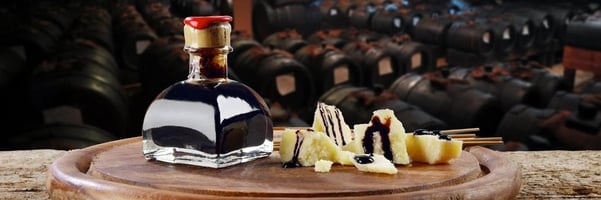
From ancient Roman traditions to the tables of Renaissance noble courts, the journey of this "black gold" is a voyage through the centuries that has shaped unique flavors and unparalleled traditions.
This precious condiment is not just a culinary element, but a testament to the history, culture, and culinary art of Italy.
Its genesis is ancient, dating back to the dawn of the III millennium B.C., when civilizations of the Near East used vinegars from grapes, apples, dates, and figs for culinary and medicinal purposes.
The roots of traditional balsamic vinegar go back to the Roman era, where the use of cooked must for vinegar production was already widespread. Lucio Columella, a Roman agronomist of the 1st century A.D., described the cooking of must as a common practice.
In the Middle Ages, vinegar was widely used south of the Alps, with a particular mention of the vinegar produced in Canossa. The Benedictine monk Donizone, in the 12th century, recounts how Emperor Henry II of Franconia requested this vinegar during a visit to Piacenza.
With the Renaissance, balsamic vinegar becomes the protagonist of aristocratic European tables, transforming into a refined and expensive condiment.
The European courts, inspired by Italian fashions, favored the growth of production, and balsamic vinegar became a symbol of status and luxury.
Lucrezia Borgia, Duchess of Ferrara, even requested it to ease the pains of childbirth.
The first written testimonies about balsamic vinegar date back to the 17th century, with Count Giorgio Gallesio and his study at a friend's Acetaia. His handwritten notes from 1839, found in the United States, constitute the oldest document on vinegar production in Modena.
During those years, balsamic vinegar began to make its way into international exhibitions and attract global attention.
Throughout the 20th century, traditional balsamic vinegar gained worldwide fame. In 1976, the Association of Producers of Traditional Balsamic Vinegar of Modena was founded, which created a production regulation to ensure quality and tradition.
In 1933, the Minister of Agriculture, Dr. Acerbo, officially recognized the "centuries-old and characteristic industry" of balsamic vinegar from Modena (somewhat the gastronomic capital of the Emilia Romagna).
In 2000, the European Union recognized the PDO, and in 2009, the designation was officially registered.
Traditional Balsamic Vinegar of Modena PDO is the highest expression of tradition. Limited in production, with an exclusive price, it represents the pinnacle of Modena's vinegar-making art.
The particular pedoclimatic characteristics of the territory and the skills passed down over time merge to create this distinctive product, one of the symbol products of Italy in the world, along with Pasta di Gragnano (here you find the story of Pasta di Gragnano), EVO oil, Parmigiano Reggiano and PDO cheeses, Parma Ham, traditional desserts, Alba truffle and many other products.
 S&M
S&M


We recommend that you enjoy




✔ You have added the product to your cart!