By clicking on FOLLOW and confirming your registration, you will begin to receive updates via email and in your private area, when I insert a new product, inspiration or content regarding this manufacturer.
By clicking on FOLLOW and confirming your registration, you will begin to receive updates via email and in your private area, when I insert a new product, inspiration or content regarding this manufacturer.
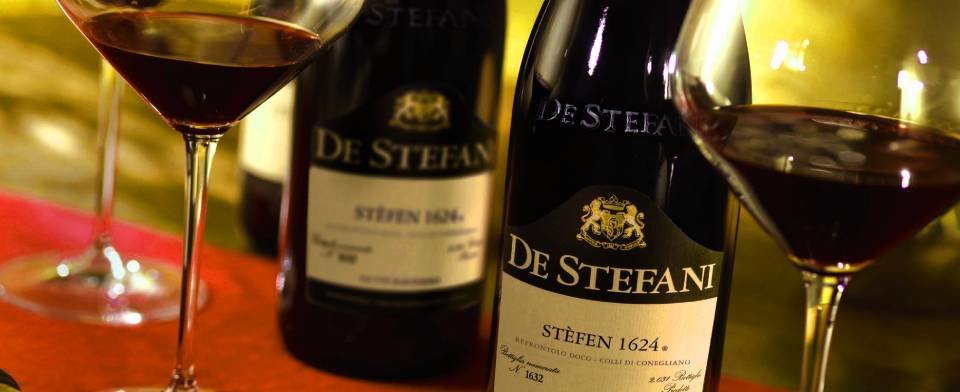
The De Stefani family originates from Refrontolo, a hilly village in Veneto, Italy, as evidenced by official documents from 1624.
In the second half of the 1800s, Valeriano De Stefani, the founder, identified the best lands to produce wines with distinctive personality at the Colvendrame estate in Refrontolo, on the hills between Conegliano and Valdobbiadene, north of Venice.
His son Valeriano, the second generation, inspired by his meticulous wife Angelina, began the tradition that the De Stefani family has always adhered to: total dedication to uncompromising quality.
Tiziano, the third generation, ventured into the Piave valley, identifying the highly suited lands in the Le Ronche estate in Fossalta di Piave and Pra' Longo in Monastier di Treviso, both northeast of Venice and located near the Adriatic Sea and the Dolomite mountains. Respecting the ancient family traditions, he brought important qualitative innovations in vineyard management and winemaking.
Today, Alessandro De Stefani, fourth generation, produces wines following a very natural philosophy, from old vines with very high density. By enhancing native grape varieties, he has developed a global distribution, with a limited production of 400,000 bottles annually produced from 60 hectares of vineyard, noted in the most important Guides.
10 Good Reasons to Choose De Stefani
1. Four generations in the De Stefani family vineyards!
For four generations, we have passed down the passion for vine cultivation and the art of producing wines of rare personality.
2. Perfect microclimate!
Our vineyards are located in Veneto, in the Piave valley, between the Adriatic Sea and the Dolomite mountains, and in the hills between Conegliano and Valdobbiadene.
3. A unique soil: the Caranto!
Our grapes grow in a soil called "Caranto", considered by many scientists to be one of the best for viticulture. It is a special combination of clay, silt, and minerals from the Dolomites.
4. 8,400 vines per hectare over 30 years old!
We have vineyards over 30 years old with 8,400 vines per hectare trained to the Guyot system. This allows us to produce very little grape per plant, between 350 and 950 grams, resulting in great concentration and aromatic richness of the grapes.
5. Native grapes and single vineyards!
We produce original wines mainly obtained from indigenous varieties: Marzemino, Raboso, Refosco, Glera , and Tocai. For some wines that we bottle, we use grapes sourced from a single vineyard to emphasize the characteristics of this small area.
6. Unique winemaking techniques!
To give more character to our wines, we use special winemaking techniques, including our exclusive "Metodo Zero" and the drying of the grapes.
7. We respect nature!
We operate according to organic and biodynamic principles. We vinify our wines without any addition of sulfites. We produce 100% of the energy we use with our 418 solar panels. We let the must ferment with our indigenous yeasts!
8. We bottle only worthy vintages in limited quantities!
To ensure the quality offered, we bottle only the vintages that meet our quality expectations. The quantity is limited to the restricted production of each wine, making it a handcrafted product.
9. We are featured in all major wine guides!
Our wines are highlighted and recommended by all the main international wine guides: Wine Spectator, Robert Parker Wine Advocate, James Suckling, Gambero Rosso, Slow Food, Associazione Italiana Sommelier, Veronelli, Espresso, Luca Maroni, and Touring Club.
10. DE STEFANI wines in over 40 countries worldwide!
Our wines are imported by the best operators in the industry in restaurants and the most qualified wine shops in over 40 countries around the world, across 5 continents.
 /
Producers
/ De Stefani
/
Producers
/ De Stefani