By clicking on FOLLOW and confirming your registration, you will begin to receive updates via email and in your private area, when I insert a new product, inspiration or content regarding this manufacturer.
By clicking on FOLLOW and confirming your registration, you will begin to receive updates via email and in your private area, when I insert a new product, inspiration or content regarding this manufacturer.
Talking with Luigi Ruffo is always a pleasure and a discovery; what shines through from his stories and hands is the deep passion this farmer has for his land, his olive groves, and his precious bees, which he affectionately refers to as tireless workers.
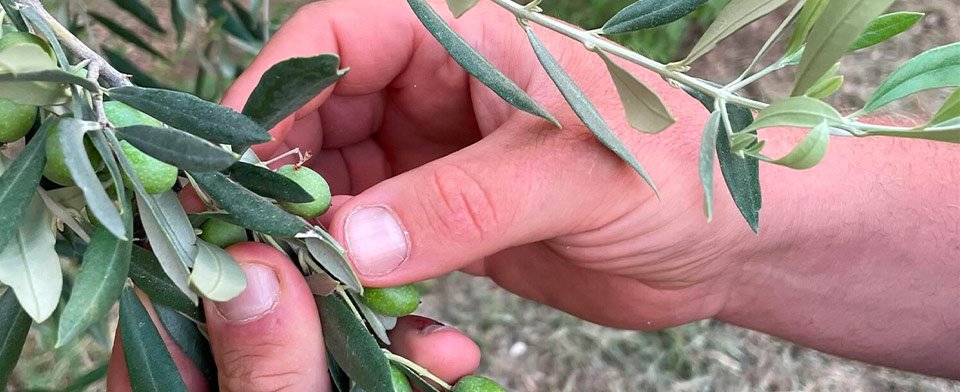
The most challenging yet rewarding adventure began in 2006, when Luigi inherited a small olive grove from his father that would become the cornerstone of his farm. Over the years, thanks to a fervent curiosity and absolute dedication, this young farmer begins to experiment with new techniques of natural cultivation, based on full respect for the plants and the decision not to use highly polluting chemical products.
A farm where nature sets the pace
All cultivation and product transformation procedures follow a strict organic certification protocolby the ICEA Authority. The small size of the farm also allows for manual working methods and for daily monitoring of production and the level of well-being of the crops.
In Luigi's farm, the indisputed ruler is Nature, which dictates the rhythms and thus determines the annual production. Firmly believing in agriculture that does not force the laws of nature, no synthetic chemical molecules are imposed on the plants to achieve the desired production. The fruits are harvested by hand between October and November, and the milling of the olives is done twice a day to preserve their qualitative characteristics.
The most suitable soil for each cultivar
Thanks to a particularly favorable soil for olive cultivation, Luigi is able to produce oil of the highest quality, so much so that booking is almost mandatory. The farm is located in Cellore di Illasi, in the eastern area of Verona, on the slopes of Monte Garzòn where the microclimate and the extremely calcareous soil allow the maximum expression of the Grignano cultivar, a variety of Brascian origin, transplanted in the Verona area around 1800, characterized by its great resistance to cold and humid climates and having a unique aromatic potency.
Over time, the plots of land in the eastern Verona that have gradually expanded the farm have been meticulously selected from nearby towns with the aim of finding the most suitable and dedicated lands for each cultivar, thus diversifying the production of oil. For example, in Colognola ai Colli, the Leccino is grown, giving us an oil with scents of aromatic and wild herbs typical of the cultivar, combined with notes of flint and smoky coming from the volcanic nature of the land, typical of the area.
In contrast to the olive groves of Montorio, one of the areas where olive cultivation dates back to ancient times, the Valpolicella DOP is obtained, an extremely balanced oil thanks to the age of the plants, which can exceed 500 years.
Bees: from natural techniques for olive cultivation to uncontaminated honey
Among the biological techniques used by Luigi is also the use of infusions of medicinal and aromatic herbs, serving as natural pesticides and insecticides, also derived from the work of bees. Driven by these alternative models, in 2019 Luigi decided to further enrich his experience by venturing into honey production. By visiting his farm, you can indeed admire and touch the ten small colorful hives arranged along the ancient Wool path, where the uncontaminated environment allows the bees to gather healthy nectar free from chemical contamination. With the help of these little creatures, Luigi now produces five types of honey: wildflower, cherry, acacia, dandelion, and chestnut.
 /
Producers
/ Azienda Agricola Luigi Ruffo
/
Producers
/ Azienda Agricola Luigi Ruffo