 / Our magazine / The "cousins" of taralli: Italy's snack journey.
/ Our magazine / The "cousins" of taralli: Italy's snack journey.
/ Our magazine / The "cousins" of taralli: Italy's snack journey.
In Italy, just setting something crunchy, a bottle of wine, and some appetizers on the table transforms any moment into conviviality. Puglian taralli are perhaps the most famous symbol of this tradition: simple, fragrant, rustic, perfect to accompany olives, pickles, cold cuts, cheeses, and preserves. But what many do not know is that every Italian region has its own “cousin of the tarallo,” a baked product meant to be shared, broken with hands, and savored slowly.
The flours, textures, shapes, and aromas change, but the role remains the same: to accompany the taste of the territory and create sociality. From Piedmontese grissini to Sardinian pane carasau, through schiacciatine, friselle, crescie, and crostini, Italy preserves an incredible heritage of crunchy specialties that deserve to be told.
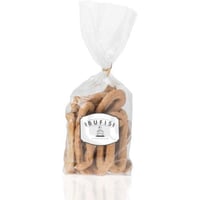
The tarallo was born as a poor but brilliant product. Flour, extra virgin olive oil, white wine, and a few other ingredients become something irresistible. In Puglia, tarallo is everywhere: in bars, on festive tables, next to platters of cold cuts, and even during daily breaks.
Its strength lies in versatility. The classic tarallo pairs wonderfully with seasoned olives, sun-dried tomatoes, eggplants in oil, and stuffed peppers. The versions with fennel, chili, or onion become even more gastronomic and perfect for important aperitifs.
Alongside the taralli, there are also scaldatelli, larger, rustic, and spiced, often enriched with seeds and Mediterranean herbs. They are less delicate but even more convivial: ideal with Southern white wines, craft beers, or a glass of young Primitivo.
On Spaghetti & Mandolino, there is a category dedicated to taralli and regional baked products, perfect for creating an authentic Italian aperitif.
If the South speaks the language of tarallo, Piedmont responds with grissini. Born in Turin, the grissino is one of the absolute symbols of the Italian table. Thin, dry, and fragrant, it elegantly accompanies cold cuts, cheeses, and delicate appetizers.
The most fascinating ones are the grissini rubatà, hand-stretched, irregular, and rustic. They have a fuller texture and a flavor reminiscent of traditional bread. They are extraordinary with lardo, Cantabrian anchovies, Piedmontese giardiniera, and blue-veined cheeses.
Piedmont has transformed the aperitif snack into a refined gesture. Where the Puglian tarallo is convivial and immediate, the grissino plays on balance and lightness.
In the North-East, we find another universe: that of schiacciatine and thin layers. Crunchy, light, and often prepared with extra virgin olive oil, they are ideal for modern aperitifs.
The schiacciatine work very well with vegetable creams, Taggiasca olives, fresh cheeses, and delicate cold cuts. They are less “intrusive” than taralli and leave space for the flavors of the accompaniments.
In Veneto, especially in the areas of Venetian bacari, these baked products become the perfect base for small appetizers with baccalà mantecato, sarde in saor, or sweet and sour vegetables. The balance between crunchiness and softness is fundamental here.
Central Italy completely changes perspective. Here the absolute protagonist is the bread. Unsalted bread, oil-based schiaccia, rustic crostini, and light focacce become the ideal support for more intense appetizers.
Tuscany, for instance, uses bread as a neutral canvas. Its low salt content allows it to enhance pâtés, olives, cold cuts, and preserves. A crostino with liver cream or artichokes in oil immediately tells the story of the territory.
The Tuscan schiaccia, fragrant outside and soft inside, pairs beautifully with pecorino, finocchiona, and grilled vegetables. In Umbria, the bread becomes even more rustic and is often combined with truffles, mushrooms, and woodland preserves.
Here the “cousin of the tarallo” is never a snack in itself: it always forms part of a broader tasting experience, rich and rustic.
Between the Adriatic and the Apennines, we find two great protagonists of Italian conviviality: the crescia marchigiana and the Romagna piadina.
The sfogliata crescia is rich, flavorful, and often perfumed with pepper. It has an almost buttery consistency that pairs very well with important cold cuts, pecorino, and rustic preserves.
The piadina, however, is perhaps the most versatile product in Italy. Cut into wedges during the aperitif or in the Fantapiada version, it can accompany practically everything: giardiniera, fresh cheeses, cold cuts, olives, vegetables in oil, and even preserved fish.
Unlike the tarallo, which remains crunchy and dry, piadina and crescia add softness and enveloping qualities. They are more “welcoming” products, designed to contain and accompany.
Few Italian products tell the land as much as pane carasau. Thin, crunchy, and very light, it originated as bread for Sardinian shepherds because it could be preserved for a long time during transhumance.
Today it is one of Italy's best gastronomic accompaniments. Broken by hand, carasau pairs perfectly with aged pecorino, olives, sun-dried tomatoes, bottarga, and fish preserves.
The “guttiau” version, with oil and salt, evokes even more the concept of convivial snack. It is probably the Italian product that best manages to combine rusticity and refinement.
In the far South, the bread is infused with sun, sesame, oil, and intense aromas. In Sicily, there exist many toasted breads and savory biscuits made from hard wheat perfect for caponata, olives, capers, and eggplants in oil.
Calabria adds the character of chili pepper. Here, the crunchy product must withstand strong flavors: nduja, sweet and sour red onions, crushed olives, and spicy preserves. For this reason, rustic breads, friselle, or simple taralli are often chosen to balance the taste without overpowering it.
The most fascinating thing is that all these products arise from the same idea: to create something simple, preservable, and perfect for sharing.
The Puglian tarallo, the Piedmontese grissino, the Sardinian pane carasau, or the Venetian schiacciatina are not just “snacks.” They are tools of conviviality. They serve to bring people together, to accompany a glass of wine, to slow down time around a table.
And it is precisely this that makes the Italian tradition of appetizers extraordinary: the ability to transform poor and simple ingredients into small daily rituals of pleasure.
Today, creating a regional aperitif means taking a journey through Italy. Just choose a crunchy product, pair it with preserves, cold cuts, cheeses, or pickles, and let yourself be guided by the flavors of the territory. Because each region has its own way of telling conviviality, but they all speak the same language: that of good shared food.
 S&M
S&M
We recommend that you enjoy



✔ You have added the product to your cart!